
Quick Answer:
A Dane Doodle is a cross between a Great Dane and a Goldendoodle. It is usually a large, affectionate dog with a wavy or curly coat, but size, coat, and temperament vary from puppy to puppy. It suits owners who have the space, time, and budget for a giant-breed dog.
What Is a Dane Doodle?
A Dane Doodle is a hybrid of a Great Dane and a Goldendoodle, which is itself a Golden Retriever and Poodle mix. The Goldendoodle parent’s generation can also influence coat and size. With three breeds in the background, puppies from one litter can look and act quite differently. Some are tall with long legs and wavy coats, while others have straighter coats or a build closer to one parent.
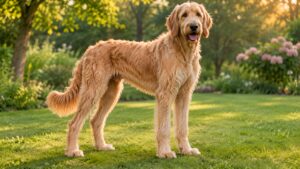
This is not a standardized breed, so appearance and personality can’t be guaranteed.
Size and Appearance
There is no official size standard for this cross. Adult size depends on the Great Dane parent, the size of the Goldendoodle parent, and genetics.
| Characteristic | What to expect |
|---|---|
| Adult weight | Roughly 75–150 pounds |
| Adult height | Roughly 24–32 inches at the shoulder |
| Coat type | Straight, wavy, or curly |
| Coat colors | Cream, gold, black, brown, gray, or mixed patterns |
| Build | Tall, long-legged, athletic, sometimes broad-chested |
| Shedding | Varies from low to moderate |
These are broad possibilities, not promises. A Dane Doodle bred from a smaller Goldendoodle parent may be noticeably smaller. For more on coat colors, see our full guide.
Common features include long legs, floppy ears, a longer muzzle, and a wavy coat. Don’t assume every Dane Doodle has a low-shedding coat, since coat type can differ even within one litter.
Temperament
Great Danes are known for a friendly, dependable nature, and Goldendoodles are usually sociable and eager to learn. Dane Doodles are often affectionate, intelligent, playful, and loyal. Personality still depends on genetics, early experiences, socialization, and training.
Good family dogs? They can be, when properly socialized and trained. Because of their size and strength, they need supervision around young children. Even a friendly dog can knock over a small child during play.
Easy to train? Many learn quickly, especially when training starts early and uses consistent rewards. Focus on:
- Sit, stay, come, and leave it
- Walking calmly on a leash
- Greeting people without jumping
- Settling quietly indoors
- Accepting brushing, bathing, and vet exams
Tip: Teach loose-leash walking while your puppy is small. A 100-pound dog that pulls is much harder to manage.
How to Care for a Dane Doodle
Exercise
Most Dane Doodles need daily walks, supervised play in a secure yard, short training sessions, and mental games like food puzzles and scent work. Avoid long runs, repetitive jumping, and strenuous exercise while puppies are still growing. Ask your vet when higher-impact activity is appropriate.
Grooming
Wavy or curly coats need frequent brushing to prevent tangles and mats, and straighter coats still need regular brushing. A basic routine includes:
- Brushing several times a week, down to the skin
- Extra attention behind the ears, under the legs, and around the collar
- Regular ear checks, keeping ears clean and dry
- Nail trims and tooth brushing
- Professional grooming when the coat needs it
Goldendoodle-type coats can be high-maintenance, so include grooming in your budget. Learn more about shedding and allergies and mat prevention.
Diet
Feed a complete, balanced diet suited to your dog’s life stage. Puppies from large or giant lineages may do best on a large-breed puppy food that supports controlled growth.
- Measure meals instead of leaving food out all day
- Monitor body condition, not just weight
- Keep fresh water available
- Ask your vet about portions and supplements
Don’t add calcium supplements to a complete puppy diet unless your vet recommends them, because excess or unbalanced minerals can interfere with healthy bone development.
Training and Socialization
Introduce your puppy gradually to different people, friendly dogs, everyday sounds, and new places, keeping each experience calm and positive. Reward-based training works well, and consistency matters most for a dog that may end up taller and stronger than you expect.
Home and Space
A Dane Doodle can adapt to different homes, but more space makes life easier. Plan for an adult-sized bed, crate, vehicle space, and walking gear. A yard helps but doesn’t replace daily walks, interaction, and training. Our new puppy checklist can help you prepare.
Health Concerns and Lifespan
A Dane Doodle may inherit health risks from Great Danes, Golden Retrievers, and Poodles. Being a mix doesn’t guarantee better health, so responsible breeding and regular vet care matter.
- Hip dysplasia: a joint condition that can cause pain and trouble moving
- Heart conditions: some inherited heart diseases occur in the parent breeds
- Bloat (GDV): a life-threatening condition in which the stomach expands and may twist, especially in large, deep-chested dogs
- Eye conditions: certain inherited disorders, depending on ancestry
- Ear and skin problems: floppy ears and dense coats need extra attention
Lifespan: About 8–12 years is a reasonable estimate. It is based on related large crosses, not on research specific to this mix, and individual dogs vary.
Health tips:
- Ask your vet about heart and joint screening.
- Request documented health-test results for both parents. See why health-tested Goldendoodles make better pets.
- Keep a healthy weight and schedule regular checkups.
- Ask whether preventive gastropexy is appropriate.
- Seek emergency care for a swollen abdomen, repeated unproductive retching, or sudden restlessness with heavy drooling, as these may signal GDV.
For general puppy care, see our vaccination guide.
Is a Dane Doodle Right for You?
| Your situation | Good fit? |
|---|---|
| You have time for daily exercise and training | Potentially a good fit |
| You want a friendly, interactive companion | Potentially a good fit |
| You have a limited grooming budget | May not be ideal |
| You are away for long periods | May not be ideal |
| You have very young children | Possible, with close supervision |
| You need a guaranteed non-shedding dog | Not a reliable choice |
Before choosing a puppy, meet the parent dogs if possible and ask about their temperaments, health histories, adult sizes, and grooming needs.
Final Thoughts
The Dane Doodle can be a loving, intelligent companion, but its final size, coat, and temperament are hard to predict. Look beyond appearance and think about long-term care. With responsible breeding, early training, regular grooming, good nutrition, and preventive vet care, it can thrive in the right home.
If you love the Doodle personality but want a more manageable size, read about buying a Goldendoodle puppy in Florida or browse our available Goldendoodle puppies.
FAQs
How big does a Dane Doodle get?
Many weigh roughly 75–150 pounds and stand 24–32 inches tall, but these are possible ranges, not standards.
Is a Dane Doodle hypoallergenic?
No dog can be guaranteed hypoallergenic. Some inherit a lower-shedding curly coat, while others shed more. If you have allergies, spend time with the individual dog before bringing a puppy home. See our guide to Goldendoodle allergies.
Are Dane Doodles aggressive?
Not inherently. Temperament varies, and socialization, responsible breeding, and consistent training all help.
Do they shed a lot?
It varies. Curlier coats tend to shed less visibly, and straighter coats may shed more. Even low-shedding dogs need regular brushing.
Good for first-time owners?
Possibly, if you are ready to invest in training, grooming, exercise, and vet care. Early leash training and firm, consistent boundaries are especially important.
Is a Dane Doodle the same as a Great Danoodle?
Not exactly. A Great Danoodle is usually a Great Dane crossed directly with a Poodle, while a Dane Doodle is a Great Dane crossed with a Goldendoodle. They are related but not identical.